Do Younger NFL Teams Win More? (20-Year Data Reveals)
We analyzed 20 years of NFL data to find out if younger offenses outperform expectations and how they compare to veteran-led teams.
by Jason Lisk - Aug 8, 2025
(Photo: Mark Goldman/Icon Sportswire)
For two decades, NFL front offices have quietly been executing a major shift that is now impossible to ignore.
Offensive units are younger than they have been in more than 20 years, and the numbers say it is not a fluke. The age drop is not just cosmetic. It is structural. And more importantly, it is predictive.
This is not about one team “rebuilding” or another “going all in.” This is a league-wide recalibration toward youth as a long-term advantage.
🏈 By The Numbers NFL Newsletter 🏈
This article first appeared in our free By The Numbers NFL Newsletter, sent twice a week with expert picks, pool strategy, and data-driven insights.
Join thousands of fans who think smarter about the NFL.
From Veteran-Led to Youth-Driven
Back in the mid-2000s, NFL offenses were veteran-heavy. Most teams leaned on cores built around 28- and 29-year-old starters. But those days are gone.
Since 2003, the average AV-adjusted age of NFL offenses has steadily declined. The league has not had a season above 27.0 years since 2011. Every season since 2019 has averaged 26.7 or lower, the six youngest seasons on record. And in 2023, offenses dipped all the way to 26.5.
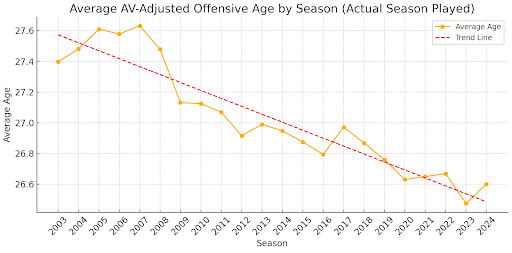
A one-year drop may sound subtle, but in practice, it is a seismic shift. League-wide, a one-year age difference translates to more than 60 lineup spots flipping from experienced veterans to rookies or second-year players. It is not just a few teams going young. It is everyone.

Premium Sports Picks
Betting - Survivor - Pick’em
Why the NFL Is Getting Younger on Purpose
Here’s why youth isn’t just a trend—it’s a strategy movement:
- Rookie contracts are cheap and valuable. The 2011 CBA capped first contracts and made them more team-friendly. Players in years 1–4 offer better ROI than mid-tier vets, so teams cycle talent more aggressively.
- The aging franchise quarterback is disappearing. The Brady–Manning–Brees–Roethlisberger era is over. Today’s QBs are younger, more mobile, and face steeper physical tolls. Long careers are no longer the norm.
- College-style schemes shrink the learning curve. Spread formations, RPOs, tempo, and motion (once college staples) are now NFL norms.
The result? Rookies contribute immediately. Stars like Justin Jefferson, Ja’Marr Chase, Puka Nacua, and Brock Bowers didn’t need “development years.”
Proof That Youth Is the New NFL Standard
In the mid-2000s, about one-third of the league had offenses older than 27.6. In the last three seasons, no team has even crossed 28.5. At the same time, young offenses under 25.5 have exploded.
From 2003 to 2012, only three teams met that threshold. Since 2021, there have been 17.
The NFL is not just tolerating youth. It is optimizing for it.
Editor’s Note: Looking for the Best NFL Survivor Picks each week? Get data-driven insights tailored to your pool with our customizable tool.
Younger Offenses Are Less Risky, More Predictable
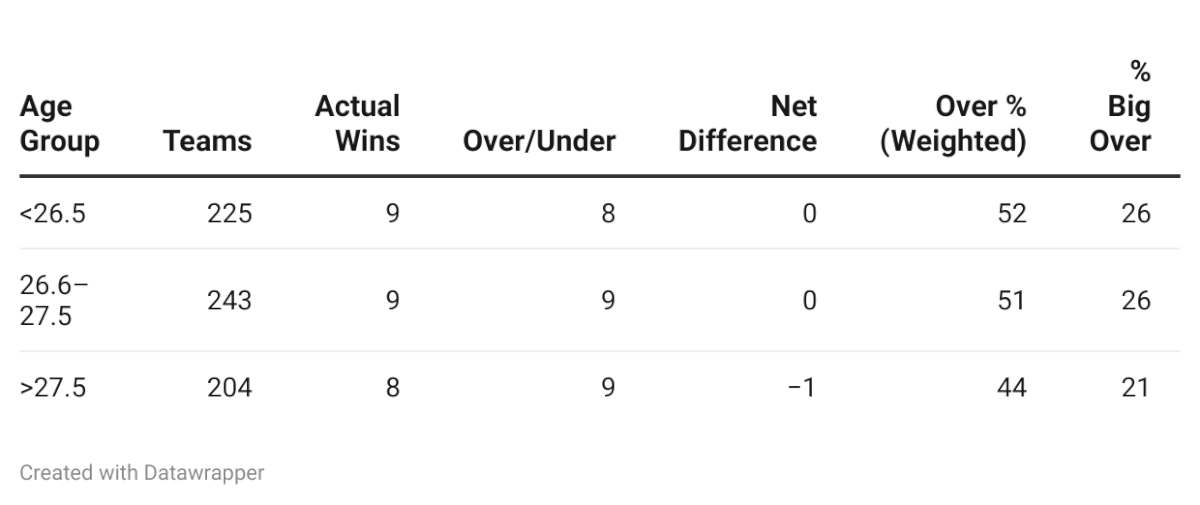
Even before the recent decline in average age, older offenses were a riskier bet when it came to living up to expectations. (All results are prorated to a 17-game basis for consistency.)
Compared to teams with an average AV-adjusted offensive age of 27.5 or younger, older teams were:
- Far less likely to go over their preseason win total
- Far more likely to underperform by 2 or more wins
The “Big Over” and “Big Under” figures in our tables reflect how often teams outperformed or underperformed their win total by 2.0 or more wins. That is a meaningful gap, given how win totals are typically set.
The NFL Has Turned the Page on Aging Offenses
Before 2019, it was rare for a very young offense to be projected as a playoff team.
From 2003 to 2018:
-
Only 3 offenses under 25.5 had a preseason win total of 9.0+
Since 2019:
-
That number has jumped to 11
Teams like the Ravens, Bengals, and Packers have shown that youth can deliver immediately. The old model—sit and wait—is gone.
The Youth Movement Is Here to Stay
This is the new normal. The Brady–Manning–Brees model of gracefully aging into your late 30s is no longer viable. Even top-tier stars are being churned out through systems built around youth, upside, and financial flexibility.
The cautionary tales?
-
The Jets and Browns had the two oldest offenses in 2023
-
Both leaned heavily on aging veterans
-
Both collapsed
Few teams will copy that blueprint in 2025. Expect:
-
Lower average ages
-
More rookies starting
-
Youth as a sustainable edge, not a rebuild necessity
Like This Article?
Get smarter NFL insights all season long, because Data > Clickbait.